Garage door insulation:
What the Numbers Actually Mean.
The metrics manufacturers advertise are often not the ones that matter. Here is how to read past the marketing and what to look for.
It bonds to the door, performs better, and usually costs only a little more. Polystyrene is fine at the right price. But if someone calls it "just as good" and cites an R-value to prove it, they are skipping the part that matters.
This is the U-factor verified by DASMA, the Door and Access Systems Manufacturers Association, under a standardized test that makes doors comparable across brands. The testing is voluntary, so a manufacturer with a mediocre result can simply not publish it.
A well-installed mid-range door beats a poorly installed premium door. Seal fit and perimeter contact matter as much as the spec sheet.
Before the metrics, answer this. The right door depends on how your garage is built and used, and the highest-performing door is not the right answer for every situation.
- You heat or condition the garage: If you run heat in the space, attached or detached, the door's performance shows up on your winter bills. This is where the difference between a top-performing door and an average one becomes a real number every winter.
- Living space above or beside the garage: A bedroom over the garage or a room sharing its wall makes the garage temperature part of your comfort and heating load. A well-insulated door keeps that buffer warmer.
- Unheated detached garage: No temperature to manage and no shared boundary with the house. A reasonably insulated door with a good seal is the right call. The gain from a premium door is real but small.
- Attached garage with limited shared living space exposure: The garage is attached but shares little boundary with conditioned rooms, perhaps one wall against a closet or a connection through a mudroom. The case for a top-performing door is weaker than when a bedroom sits above. Solid polyurethane and a clean install serve well.
Most product claims are self-correcting. Advertise an unrealistic 0-to-60 time and journalists test it, publish, and expose it. Garage door insulation does not work that way. You can feel that your garage is cold, but you cannot easily tell whether that is the weather or the door losing more heat than it should. That gap between what you feel and what you can verify is where misleading marketing survives.
Residential windows went through this a generation ago. Manufacturers sold center-of-glass R-value until the industry adopted a whole-window U-factor through the National Fenestration Rating Council (NFRC), and the old number quietly disappeared from window marketing. DASMA's Thermal Performance Verification Program is the same shift, now underway for garage doors.
The most common manipulation: R-value is calculated at the center of one insulated panel, isolated from the frame, joints, seals, and hardware. That is the best case for one section of material, not the door you install. And because no rule forces brands to calculate it the same way, published R-values often are not even comparable to each other.
The R-value on the sticker describes one component, calculated in isolation under ideal conditions. It tells you almost nothing about how the installed door performs in a Minnesota winter.
Three metrics dominate garage door thermal claims. They measure different things and deserve very different levels of trust.
What It Measures
Resistance to heat transfer through a material. Higher is better. The idea comes from building insulation, where it works because the insulation fills a continuous, bounded cavity.
Where It Breaks Down for Garage Doors
A garage door is a moving assembly: joints between every section, a steel frame, perimeter seals, and hardware penetrations. R-value describes only the insulated panel center, none of those other heat-loss paths. So a door can post a high R-value and still lose much of it through the frame, joints, and seals.
Why R-Value and U-Factor Do Not Match
For one uniform material in isolation, R-value and U-factor are exact reciprocals: R = 1 / U. In a classroom they are interchangeable.
The pure arithmetic, for reference: R-6 is U-0.167, R-10 is U-0.100, R-12 is U-0.083, R-16 is U-0.063, R-18 is U-0.056. Lower U is better.
A garage door breaks this, and DASMA says so directly: a tested U-factor is not the inverse of a calculated R-value, because the two come from different methods. R-value is calculated through the center of one panel. The DASMA U-factor is a physical test of the whole door. A single door's published R and U will never line up through the formula, and the distance between them is everything the panel number left out.
Wayne Dalton publishes both numbers on its Classic Steel doors, which makes the gap visible. Two of them share the same tested U-factor of 0.26 while showing different R-values:
| Model | Panel R-Value | Tested U-Factor | Whole-Door R from 1/U | What It Tells You |
|---|---|---|---|---|
| 9100 (7' door) | R-9 | 0.26 | R-3.8 | Panel R is about 2.3x the whole-door figure |
| 9605 (8' door) | R-10 | 0.26 | R-3.8 | Panel R is about 2.6x the whole-door figure |
Two doors, two R-values, one identical tested U-factor. The panel R barely tracks how the assembled door performs. This is not a knock on Wayne Dalton: publishing both numbers, and labeling the panel R as calculated, is the transparent thing to do. The gap is true of every insulated steel door on the market, though the size of the gap can vary substantially.
The Bottom Line
R-value is not useless. A door with real polyurethane insulation and an R-value of 12 to 18 beats an uninsulated one easily. But it is not a reliable way to compare brands, and the highest R-value claims on the market deserve the most skepticism. When both numbers exist, use the U-factor. When only the R-value is published, ask why.
What It Measures
Heat transfer through the entire door assembly: panels, frame, rails, joints, and hardware. Lower is better. The DASMA 105 test puts a full door in a calibrated hot box under standard conditions and measures what passes through, capturing the thermal bridging that R-value ignores.
Why It Is the Best Single Measure
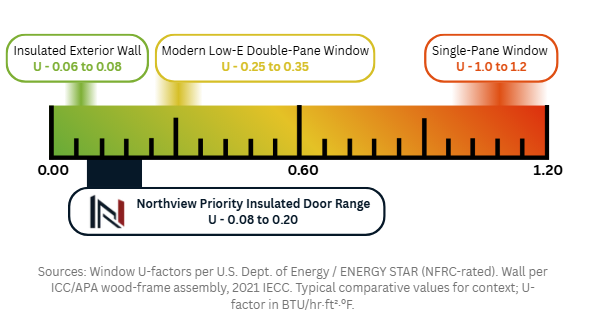
Because it measures the whole assembly, the U-factor captures the frame, joint, and seal losses that a center-of-panel R-value misses. That makes it the single best indicator of how well a door will actually keep the cold out. It is also standardized, so a 0.17 means the same thing from any brand that publishes it, and a door at 0.10 is genuinely better than one at 0.20 whatever either claims for panel R-value.
The Bottom Line
This is the number that should anchor the decision. When a manufacturer does not publish one, that absence is itself informative. A strong number is a selling point, and manufacturers publish their selling points.
What It Measures
The volume of air passing through the closed door at a set pressure, in cubic feet per minute (CFM) per square foot. The test behind it, ASTM E283, a recognized standard from the standards organization ASTM International, is legitimate, and air leakage is a real heat-loss path. It is separate from the U-factor: in the DASMA 105 thermal test the door's openings are sealed, so air infiltration is measured on its own rather than folded into the U-factor.
How to Read It
Air infiltration is a legitimate, code-relevant measure, and the manufacturers who publish it generally do so alongside the U-factor in commercial documentation. It is not a substitute for the whole-door U-factor, and it is not a number a homeowner needs to chase on its own. When you are comparing doors, the U-factor still captures overall heat loss in one standardized figure. Treat air infiltration as useful supporting detail, not the headline.
Clopay is the largest residential garage door brand in the country. On its commercial doors it tests and publishes DASMA U-factors, and its own materials explain why a whole-door U-factor is more accurate than a calculated R-value. On the residential doors it sells to homeowners, it leads with an R-value of 18.4, a calculated section figure, and does not put a tested DASMA U-factor in front of you.
The capability is there. The understanding is there, in their own words. So it is fair to ask why the more honest number is the one that does not reach the residential buyer. A best-in-class U-factor would be worth advertising, and manufacturers advertise their best numbers. When a company that plainly knows better leads homeowners with the calculated figure instead, the choice itself is worth noticing.
DASMA U-factors across the market run from roughly 0.08 to 0.30 and higher. That spread is not mainly about insulation thickness. It is about whether the door's construction eliminates the thermal bridging that loses heat at the joints.
Steel conducts heat well. Without a thermal break, each section's steel skin runs to the joint edge and meets the steel of the next section, a direct low-resistance path straight past the insulation. Fill the panel with the best foam available and you still lose heat through the steel at every joint.
Insulation stops heat from moving through the panel. A thermal break stops it from moving around the panel. When thermal performance is the priority, you need both.
Without a Thermal Break
Steel skins reach the section edge, so steel meets steel at the joint, and heat flows through it no matter how well the panel is insulated. The tested U-factor ends up much worse than the center-panel R-value implies. This is common in builder-grade and many mid-range insulated steel doors.
- Metal-to-metal contact at every section joint
- High thermal bridging through the steel frame
With a Full Thermal Break
Haas uses rigid vinyl caps in a tongue-and-groove joint across its insulated steel line. The caps wrap the steel edges, so sections meet vinyl to vinyl, not steel to steel. Vinyl barely conducts, so the thermal bridge is gone at every joint and the foam can do its job.
- Rigid vinyl caps isolate the steel edges at every joint
- Tongue-and-groove keeps joint contact consistent
- The thermal break is what drives Haas U-factors below market averages
The Haas insulated steel line spans three thickness tiers. Once the thermal bridging at the joints is solved, adding insulation thickness barely moves the number:
| Haas Series | Insulation Thickness | Tested U-Factor | Whole-Door R from 1/U |
|---|---|---|---|
| 600 Series | 1-3/8 in | 0.106 | R-9.4 |
| 700 Series | 1-3/4 in | 0.093 | R-10.8 |
| 2000 Series | 2 in | 0.094 | R-10.6 |
The 700 and 2000 series perform almost identically despite the 2000's thicker insulation, and the 600, at two-thirds the thickness, beats many 2-inch competitor doors that lack a real thermal break. This runs the R-value logic in reverse: if added thickness barely moves the U-factor, a high R-value built on a thicker panel is not telling you what you think. The break is the variable that matters.
The real takeaway is the construction, not the brand. The U-factor is a better measure of real performance than any center-of-panel R-value, and the doors that earn a low one are built with a full thermal break. When thermal performance is your priority, choose a door that has one, whether that is Haas or another well-engineered manufacturer.
Two insulation materials show up in steel residential doors. The difference between them matters more than the R-value printed on either one.
- Bonded, not just set in place: Polyurethane is injected and bonds chemically to both steel skins, closing the gaps at the section edges. Polystyrene is a pre-cut board dropped into the cavity that does not bond, leaving those gaps open.
- Holds its performance: The denser bonded foam resists settling and compression as the door ages. Board stock can shift over time.
- Adds strength: Bonding to both skins stiffens the panel and improves durability.
- Often no price penalty: The premium is usually small, and in some door lines the polyurethane option is priced the same as a thicker polystyrene one.
- When polystyrene is fine: At an economy price point it is a reasonable choice and better than no insulation. It simply is not equivalent to polyurethane.
A well-installed mid-range door beats a poorly installed premium one. The spec sheet is potential. The installation is what you get.
The U-factor rates the door, not the installation. A poor seal, an out-of-square fit, or an uneven floor at the opening gives back much of the performance the rating promised.
The Two Seal Interfaces
- Bottom seal: The highest-impact point, at floor level where cold air pools, and the fastest to wear as freeze-thaw cycling cracks rubber and vinyl. A worn bottom seal on a good door leaks continuously.
- Perimeter weather stripping: The stops along the sides and top. Worn flat or set against an uneven jamb, they leave a gap on three sides of the opening. We inspect and replace these on every installation.
The Floor, Squareness, and Tracks
- Floor flatness at the opening: The bottom seal can only do so much. A sloped floor, or minor cracks and unevenness, can usually be handled with the right seal and a careful install. But a badly uneven or broken slab is more than any seal can conform to, and past that point the floor, not the door, is the limiting factor.
- Square is the foundation: A door hung square on properly set tracks closes evenly across the bottom seal. Out of square, it leaves low spots where the seal lifts off the floor.
- Track width: Set too wide or too narrow, the door closes unevenly or binds, hurting both seal contact and hardware life.
- Maintenance: A seal that was fine in fall can be compression-damaged by February. Annual seal inspection is the highest-return maintenance in this climate.
1. Start by deciding how much thermal performance matters for you. An unheated detached garage, or an attached garage with little shared living space, does not need an optimized door. A reasonably insulated door with a good seal is enough, and the money is better spent elsewhere.
2. Use the DASMA U-factor as your benchmark. It is the one standardized, whole-door number that lets you compare brands honestly. For an attached garage in Minnesota, target U-0.20 or lower. If a manufacturer does not publish a U-factor, treat that absence as information.
3. Choose polyurethane over polystyrene. Unless budget is the deciding constraint, the bonded foam is the better material, and the premium is often small or none.
4. Understand that a thermal break is what makes a low U-factor possible. If two doors have similar insulation but very different U-factors, the construction at the joints is usually why. Ask whether the door uses vinyl or non-metallic caps to break the metal-to-metal path.
5. Be skeptical of any number offered in place of the U-factor. A high R-value on its own, an air infiltration CFM figure, or a proprietary index can each be legitimate, but none of them substitute for the standardized U-factor. Ask for it.
6. Treat installation quality as equal to the product. Seal condition, squareness, track setting, and the floor at the opening decide what you actually get from the door you chose.
Questions about your specific situation?
We are happy to walk through the thermal trade-offs for your home and use case before you buy anything.