Repair & Troubleshooting
Quick answer
In the Twin Cities, Northview charges $375 for standard-cycle replacement on a two-spring residential door or $340 on a single-spring door. High-cycle replacement is $575 for two springs or $540 for one. The $45 diagnostic visit is credited if you approve the repair the same visit. Every price is published before you call, so nothing new appears once we're in your garage.
If your garage door suddenly won't budge, or you heard a loud bang from the garage followed by a door that won't open, the most likely culprit is a broken torsion spring. It's also one of the most commonly exploited repairs in the industry. A common pattern: a company quotes a service call fee, then gives you a vague, unrealistically low number like "spring replacement starts at $180" to get the appointment booked. Once a technician is in your garage and the broken spring is confirmed, you're shown two or three spring "options," usually framed around cycle life or warranty length, priced well above that starting number. Here's what this repair actually involves, what a fair price looks like, and how our approach differs from the tactics you may have heard about.
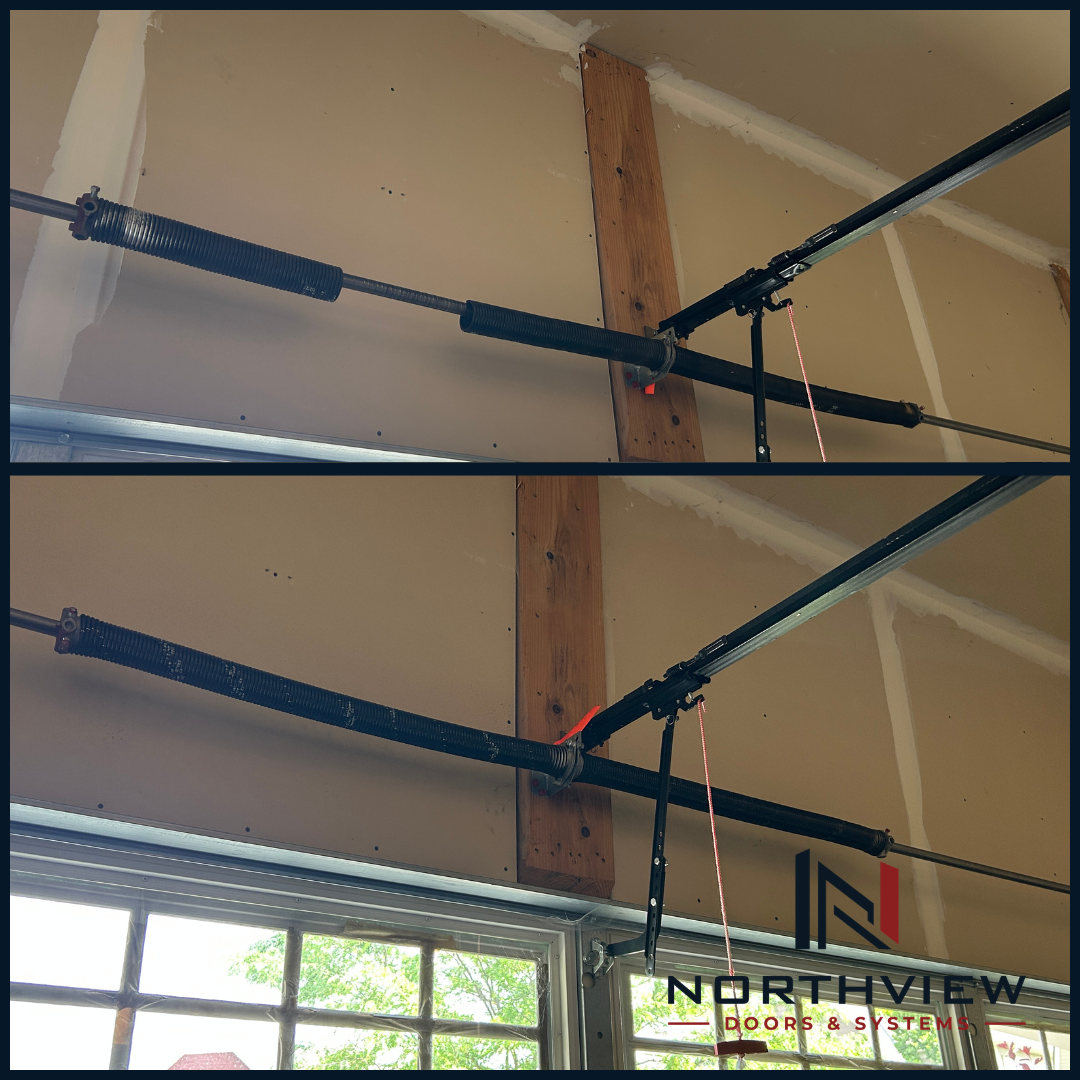
Why Garage Door Springs Fail
Torsion springs are rated for a certain number of open-close cycles, typically 10,000 to 15,000, before metal fatigue causes them to break. For an average household using the garage door a few times a day, that works out to roughly 7 to 10 years of service life, though heavy use (or a home with multiple daily drivers) shortens that window.
Minnesota's temperature swings add an extra factor. Steel contracts in extreme cold, and a spring that's already near the end of its cycle life is more likely to snap on a sub-zero morning than in July. That's why spring failures spike every winter across the Twin Cities metro. It's not a coincidence when it happens on the coldest day of the year.
Why We Charge a Flat Rate, Not a Sliding Scale
For any standard residential garage door, the spring size itself does not change our price within either spring category. That standard range covers doors up through a large 16x8 insulated steel two-car door with windows, which is about as big and heavy as residential doors get. For those who know the spring specs, we carry up to a .283 x 2" x 44" spring, which on a typical residential door setup can lift 199 lbs or more, so two of those springs can lift roughly 400 lbs. Whether your door is a smaller single-car opening or a door at that upper end, we charge the same flat rate within the selected spring category, so when you call about a spring replacement we can tell you the price instead of "we need to be on-site and it will depend on your door."
We offer two published choices: standard-cycle and high-cycle spring replacement. Both are sized to properly balance your door. Our standard springs are already sized above the industry's common 10,000-cycle baseline and are the better value for most households. High-cycle springs are designed to last through more opening and closing cycles. They typically use thicker wire and a longer spring, matched to provide the same lifting force while reducing the strain on each coil. The extra cost is a flat $200, whether your door has one spring or two.
We don't automatically recommend high-cycle springs. We consider four things: door height, daily open-close cycles, how long you expect to stay in the home, and the door's age. Taller doors and frequent use make high-cycle springs more valuable, but the upgrade makes little sense if a standard spring is likely to outlast the door or your time in the home. You can see our approach and try the same four-question recommendation tool on our high-cycle spring page. We'll explain our recommendation, including when standard springs are the smarter buy, before any work begins.
Only a door that falls genuinely outside that standard range, an oversized or heavy custom overlay door, for example, would be priced differently. We would identify that and explain it before any work begins.
Why We Always Replace Both Springs Together
On any door with two torsion springs, if one has broken, we replace both. Every time. This isn't a recommendation we offer and let you decline; it's a standard we hold on every two-spring door. Both springs on a two-spring system carry the same load for the same number of cycles from the day they're installed. When one gives out, the other is right behind it. Replacing only the one that broke saves you money for a short period of time, then costs you a second service call when the matching spring fails, often at the worst possible time. We treat that outcome as avoidable, not as an upsell opportunity, and we won't quote a two-spring door as a single-spring repair.
We'll Also Check Your Cables
Lift cables run under the same tension as your torsion springs, so it's common for cable wear to show up around the same time a spring fails. We don't replace cables automatically with every spring job. What we do is inspect them at every spring repair and tell you plainly what we see. If there's fraying or wear that warrants replacement, we'll show you the fraying (it's easy to see once someone points it out) and recommend replacement at our standard published price, the same rate every customer sees on our website. You decide. If they're in good shape, we'll say so and leave them alone.
What the Big Companies Won't Tell You Over the Phone
Many large garage door companies will quote you a service call fee up front, along with a vague, low starting price for spring replacement to get you to book the appointment. But once a technician has measured your door and given you the actual number, usually well above that starting price and broken into a "good, better, best" menu of spring options, you're commonly told you have two choices: choose from their menu and pay the price shown, or pay the service call fee, often somewhere in the $150 to $200 range, just to have the technician pack up and leave without doing the work. That fee, and the misleading "starting at" number you were quoted over the phone, is what turns a quote into pressure. Most homeowners, with a broken door and a fee looming either way, say yes to whatever repair is in front of them.
Offering longer-life springs isn't the problem. Hiding the real prices until a technician is standing in your garage is.
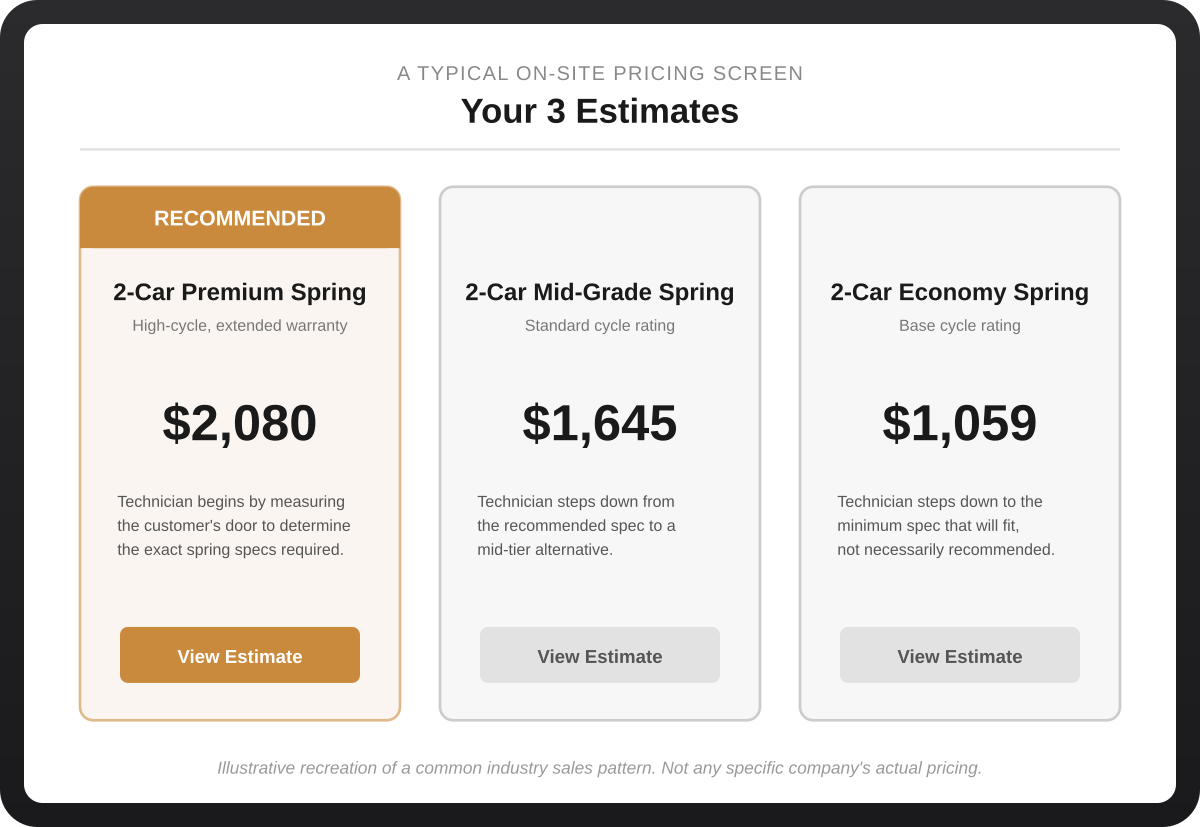
We do it differently. The prices below are what standard-cycle and high-cycle residential spring replacement cost, published before you ever pick up the phone. Any optional upgrade we offer is published the same way, and you know the service call fee and the spring replacement price up front, before you call us.
Northview's Published Spring Replacement Pricing
We publish both standard-cycle and high-cycle spring prices so you know what to expect before we arrive, not a range, not "it depends," an actual number for standard residential doors:
If you approve a spring replacement during that same visit, the $45 diagnostic is credited. You pay the repair price, not the repair price plus the diagnostic fee on top.
A note on the single-spring price: it applies to doors that were built with only one torsion spring to begin with, typically older or lighter residential doors. If your door has two springs and one has broken, you'll be quoted the double-spring price, since we replace both, not the single-spring price for a partial repair.
Where We Replace Springs
These prices apply across our Twin Cities service area, with a focus on the west and southwest suburbs. That includes Eden Prairie, Minnetonka, Chanhassen, Shakopee, Hopkins, St. Louis Park, Edina, Bloomington, Plymouth, and neighboring communities. See the full service area.
A Word on DIY Spring Repair
Torsion springs are under significant tension and have caused serious injuries when handled without the right tools and training. This is one repair we'd steer any homeowner away from attempting themselves, regardless of how mechanically comfortable they are. The spring itself is a small part of the cost. The real value in a professional repair is in the balance adjustment and safety verification that go with it.
Spring Replacement FAQ
How do I know if my garage door spring is broken?
The most common signs: a loud bang from the garage (often while the door is closed), a visible gap of a few inches in the coil of the spring above the door, a door that feels extremely heavy or won't lift more than a few inches, and an opener that strains or runs without moving the door. Loose or slack lift cables on either side are another giveaway.
Can I still open my garage door with a broken spring?
We don't recommend it. The spring is what does the lifting, so without it the full weight of the door, often well over 150 lbs, falls on you or on the opener. Running the opener against a broken spring can damage the opener and the door. If a car is trapped inside, call or text us and we'll tell you honestly how quickly we can get there.
Do spring replacement prices include new cables?
No. We inspect your lift cables on every spring job, and if they show fraying or wear, we'll show you and recommend replacement at our published cable price. If they're in good shape, we leave them alone. You decide before any additional work happens.
Do you offer high-cycle springs?
Yes. High-cycle replacement costs $540 for a single-spring door or $575 for a two-spring door, compared with $340 or $375 for standard-cycle. It is an optional upgrade, not our default recommendation. We consider your door height, daily use, likely time in the home, and door age. See the explanation and four-question recommendation tool on our high-cycle spring page. High-cycle single-spring replacements may require a special order or a discussion of converting to two springs; we will confirm the appropriate approach and price before work begins.
Is spring replacement covered by a warranty?
Yes. Standard-cycle replacement springs carry a 5-year warranty against spring breakage; springs installed as High-Cycle Spring Service carry a 10-year spring breakage warranty. If a covered spring breaks under normal operation, parts and spring-replacement labor are included, with no service-call or diagnostic fee for a confirmed covered failure. On a two-spring door, the warranty applies to each spring individually; an unfailed companion spring is replaced under warranty only when necessary for safe and proper operation. Spring replacement workmanship also carries a separate 90-day warranty. The spring warranty is nontransferable, applies to the original customer at the installation property, and is subject to the exclusions in our full warranty terms.
Should I replace my springs before they break?
The price (and the work) is the same either way, but replacing springs on your schedule means no trapped car and no emergency. If your door is 8 or more years old and used several times a day, a tune-up and safety inspection is a good time to have us check the overall condition of the door and its components. But no one can tell visually that a spring is nearing the end of its expected cycle limit.
Get a Clear Answer, Not a Guessing Game
Same-day appointment when availability allows, a clear diagnosis, and a firm price before any work starts. No bait and switch. No pressure tactics.